
Starting BTEC Applied Science? What to Expect in Year 1


Starting a BTEC Level 3 National Extended Diploma in Applied Science this September?
Whether you’ve actively chosen BTEC Applied Science or arrived here after reconsidering your options following GCSE results, you’re about to start a course that’s very different from GCSE Science.
And that’s not a bad thing.
BTEC Applied Science combines biology, chemistry and physics with practical laboratory work, scientific investigations, assignments and externally assessed units. It’s designed to help you understand science but, importantly, also to apply it.
The Extended Diploma is a substantial two-year qualification, equivalent in size to three A levels, consisting of 13 units: seven mandatory and six optional.
Your college decides how these are organised across the two years, but many students will encounter Units 1–4 during their first year, alongside optional units selected by their centre. So what can you expect?
🔬 Unit 1: Principles and Applications of Science I
Assessment: External examination
Think of Unit 1 as your introduction to Level 3 biology, chemistry and physics. You’ll build on some familiar GCSE concepts, but you’ll explore them in considerably greater depth and learn how they apply in scientific situations.
🧪 Chemistry
Topics include areas such as:
atomic structure
electronic structure
bonding
periodicity
quantities used in chemical reactions
properties and uses of substances.

You’ll also encounter calculations involving ideas such as moles, molar mass, concentration and percentage yield.
🧬 Biology
You’ll study cells and tissues, including:
animal and plant cells
cell organelles
specialised cells
epithelial tissue
endothelial tissue
muscular tissue
nervous tissue
bacterial cell structure.

You’ll need to recognise structures, understand their functions and apply your knowledge to unfamiliar situations.
🌊 Physics
The physics section focuses heavily on waves and their applications.
You’ll encounter topics including:
wave properties
diffraction
electromagnetic waves
fibre optics
communications
stationary waves.
How is Unit 1 assessed?
Unit 1 is different from most BTEC coursework because it’s externally assessed by Pearson.
You’ll sit examinations that means one of the most important lessons to learn early is:
BTEC does not mean “no exams”.
Regular revision throughout Year 1 is much easier than trying to learn the whole unit immediately before the exam.
🧪 Unit 2: Practical Scientific Procedures and Techniques
Assessment: Internal assignments
This is where BTEC Applied Science starts to feel much more like working as a scientist. Instead of simply learning about laboratory techniques, you’ll actually develop and demonstrate them.
The unit includes four main areas:
⚗️ Titration and colorimetry
You’ll learn how these techniques can be used to determine the concentration of solutions. Accuracy matters — so expect to develop your skills using equipment such as pipettes, burettes, volumetric glassware and colorimeters.
🌡️ Calorimetry
You’ll investigate cooling and produce and interpret cooling curves.
🧫 Chromatography
You’ll use chromatographic techniques to separate and identify substances within mixtures.
👩🔬 Your laboratory skills
You’ll also reflect on how your practical skills are developing and consider how you could improve your performance in the laboratory. (Pearson Qualifications)
How is Unit 2 assessed?
Unit 2 is internally assessed, so rather than sitting a Pearson exam, you’ll produce evidence through assignments and practical work.

And there’s an important mindset shift here:
Coursework isn’t automatically easier than an exam.
Achieving the higher grades requires you to go beyond simply describing what you did. You’ll increasingly need to explain, analyse, evaluate and justify your scientific work.
🔎 Unit 3: Science Investigation Skills
Assessment: External assessment
If Unit 2 teaches you how to perform practical techniques, Unit 3 develops your ability to think like an investigator.
You’ll learn how to:
plan scientific investigations
identify variables
develop hypotheses
record results appropriately
process and interpret data
identify patterns and trends
draw valid conclusions
evaluate experimental procedures
consider reliability, accuracy and validity
suggest improvements.
There’s also scientific knowledge associated with different potential investigative contexts, so this isn’t simply a test of generic practical skills. Pearson describes the unit as covering the stages and skills involved in planning investigations and recording, interpreting, concluding and evaluating scientific work. (Pearson Qualifications)
How is Unit 3 assessed?
This is another externally assessed unit, but it isn’t the same format as Unit 1. The current specification describes an assessment in which students review Part A for 45 minutes before completing a 90-minute Part B, under supervised conditions. So don’t leave your investigation skills until exam week. The more often you practise interpreting data, evaluating methods and planning investigations, the more natural these skills become.
🥼 Unit 4: Laboratory Techniques and Their Application

Assessment: Internal assignments
Unit 4 takes you further into the world of the professional laboratory. It’s not simply another practical unit. You’ll start thinking about how scientific laboratories actually operate and how techniques used at college relate to larger-scale scientific and industrial environments.
Topics include:
⚠️ Health and safety
You’ll explore why health and safety procedures are so important within scientific organisations.
🧪 Making and testing substances
You’ll investigate laboratory and industrial methods used to manufacture and test organic liquids and solids. This can include processes associated with substances such as esters, aspirin or paracetamol.
💻 Scientific information
You’ll also consider how scientific information is:
recorded
stored
retrieved
shared
communicated within scientific workplaces.
That might sound less exciting than making chemicals in a laboratory, but good data management and communication are fundamental parts of professional science. (Pearson Qualifications)
How is Unit 4 assessed?
Like Unit 2, Unit 4 is internally assessed through assignments rather than examination. You’ll therefore need to become comfortable with producing detailed scientific work that meets specific Pass, Merit and Distinction criteria.
🧬 What About the Optional Units?
This is one of the things that makes the Extended Diploma interesting. Alongside the core science studied by everyone, the qualification contains a wide range of optional units that allow programmes to explore more specialised areas. Your college chooses which optional units it offers, so you won’t necessarily study the same combination as a friend at another college.
Examples include:
Unit 8 – Physiology of Human Body Systems
Unit 9 – Human Regulation and Reproduction
Unit 10 – Biological Molecules and Metabolic Pathways
Unit 11 – Genetics and Genetic Engineering
Unit 12 – Diseases and Infections
Unit 13 – Applications of Inorganic Chemistry
Unit 14 – Applications of Organic Chemistry
Unit 20 – Biomedical Science
Unit 23 – Forensic Evidence, Collection and Analysis
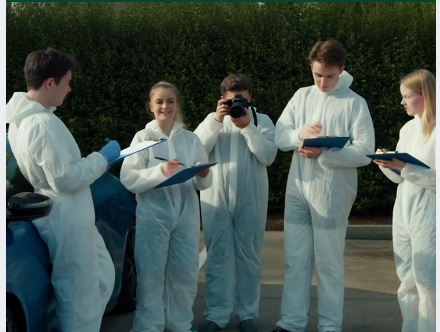
There are further specialist options too. (Pearson Qualifications). This is one of the strengths of Applied Science: depending on the programme your centre offers, you can encounter areas ranging from genetics and microbiology to forensic science, chemistry, electronics and medical physics.
📚 So, Is BTEC Applied Science Mostly Coursework?
No — and this is something worth understanding before you start.
You’ll experience a mixture of assessment. Some units, including Units 1 and 3, are externally assessed by Pearson. Others, including Units 2 and 4, are internally assessed through assignments and practical work. (Pearson Qualifications) That means you need to develop two different sets of habits:
For externally assessed units:
Revise regularly, practise calculations, learn scientific terminology and complete plenty of exam-style questions.
For internally assessed units:
Keep organised, understand exactly what each assessment criterion requires, meet deadlines and give yourself enough time to produce, review and improve your work within the assessment rules. Being good at only one of these isn’t enough.
🎯 Five Things We’d Recommend Doing From the Beginning
1. Don’t wait until your first exam to start revising.
Unit 1 contains biology, chemistry and physics. Little-and-often revision makes the workload much more manageable.
2. Keep your work organised.
Separate folders for each unit will save you a lot of frustration later.
3. Learn the command words.
Describe, explain, analyse, evaluate and justify require different kinds of answers.
4. Take practical sessions seriously.
Don’t just follow the instructions. Ask yourself why you’re carrying out each step and how it affects the quality of your results.
5. Ask for help early.
If moles, waves, cell biology or data analysis aren’t making sense in October, don’t wait until January to deal with them.
💜 Your First Year Is About More Than Getting Grades
Year 1 of BTEC Applied Science is also about learning how to be a Level 3 student.
You’ll become more independent.
You’ll learn to manage competing deadlines.
You’ll develop practical laboratory skills.
You’ll discover areas of science you’ve probably never studied before.
And you may start to get a much clearer idea of where you’d like science to take you next. The course is demanding — Pearson itself describes BTEC Nationals as demanding applied-learning qualifications — but it’s also designed to develop practical, research, analytical and transferable skills that can support progression into higher education and employment. (Pearson Qualifications)
So if you’re starting BTEC Applied Science this September, don’t worry about knowing everything on day one.
Turn up ready to learn, stay organised, ask questions and start building good habits from the beginning.
You’ve got two years of science ahead of you. Make them count. 🔬💜
Need a Little Extra Support?
Not every BTEC Applied Science student needs a tutor.
But if you find yourself struggling with a particular area, want some additional exam practice, or simply prefer having difficult concepts explained at your own pace, online Applied Science tuition can complement the support you receive at college.
At Applied Science Tutoring, we support students across biology, chemistry, physics, practical science and externally assessed BTEC units.
Sometimes getting help with a difficult topic early is all it takes to stop a small knowledge gap becoming a much bigger one later.


Comments